The difference between affiliates who earn consistently and those who burn through budgets without results often comes down to one practice: A/B testing in affiliate marketing. It's the process of comparing two or more variations of a campaign element — a landing page, an ad creative, an offer, or a traffic source — to determine which performs better based on real data rather than guesswork.
Most affiliates launch a campaign with one landing page, one offer, and one set of creatives. If it works, they scale. If it doesn't, they move on. But this approach leaves enormous amounts of money on the table because they never discover whether a different headline, image, or call-to-action button could have doubled their conversion rate.
A/B testing in affiliate marketing eliminates that uncertainty. Instead of running one version and hoping it's the best, you run two or more versions simultaneously, split traffic between them, and let real user behavior tell you which variation converts better.
Voluum is one of the most widely used tracking platforms for affiliate split testing — providing the traffic distribution, real-time analytics, and statistical tools that make controlled testing possible at scale. This guide covers what to test, how to set up tests in Voluum, how to read results correctly, and the mistakes that lead affiliates to wrong conclusions.
Understanding testing fundamentals is essential whether you're running campaigns through paid traffic, organic content, or affiliate marketing partnerships — because even small conversion improvements compound into significant revenue gains over time.
Why A/B Testing Matters More Than Most Affiliates Realize
Many affiliates treat testing as optional — something advanced marketers do after they've already found winning campaigns. In reality, testing is how you find winning campaigns in the first place.
The Math Behind Small Improvements
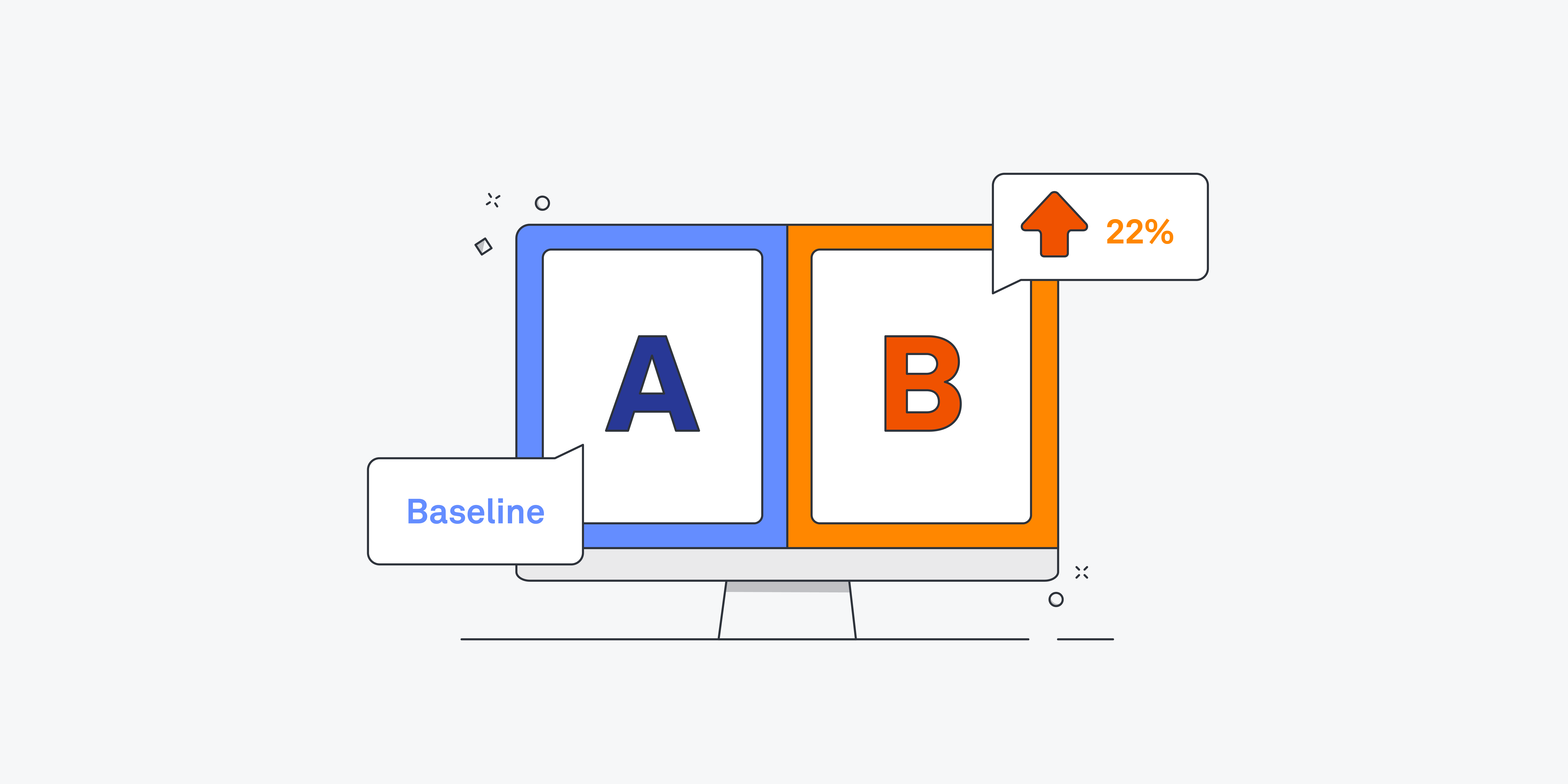
A 1% conversion rate improvement sounds insignificant. But the compounding impact is dramatic:
- Campaign A converts at 2.0% with a $50 payout. You send 10,000 clicks at $0.50 CPC. Revenue: $10,000. Cost: $5,000. Profit: $5,000.
- Campaign B (after A/B testing improvements) converts at 3.0% with the same $50 payout and traffic. Revenue: $15,000. Cost: $5,000. Profit: $10,000.
A single percentage point improvement doubled the profit — from the same traffic spend. This is why serious affiliates test obsessively. Every test that reveals a better-performing variation permanently increases profitability.
Testing Removes Opinion and Replaces It With Data
Without testing, campaign decisions are based on opinion. "I think this headline is better." "This image feels more engaging." "The blue button probably converts more than the green one." These are guesses, and guesses are wrong more often than marketers want to admit.
A/B testing replaces every opinion with a data point. The blue button doesn't "feel" better — it either converts at a higher rate with statistical significance or it doesn't. This discipline separates profitable campaigns from expensive experiments.
What Happens When You Don't Test
Affiliates who skip testing face predictable problems: campaigns that could be profitable stay unprofitable because the landing page underperforms. Scaling decisions are made on incomplete data — pouring more budget into a version that isn't optimal. And competitors who do test eventually outperform you on the same traffic sources because their conversion rates are higher.
What Elements Should You A/B Test in Affiliate Campaigns?
Not everything is worth testing. Focus on elements that have the largest potential impact on conversion rates and campaign profitability.
Landing Page Variations
Landing pages have the most direct impact on conversion rates. Elements worth testing include:
- Headlines — the first thing visitors read. Test different value propositions, emotional angles, question-based vs statement-based headlines, and specificity levels ("Save Money" vs "Save $247 on Your Next Order").
- Hero images and videos — test product images vs lifestyle images, video vs static, and different visual compositions. Visuals often impact conversion more than copy.
- Call-to-action buttons — test button text ("Get Started" vs "Claim Your Discount" vs "Try Free for 30 Days"), button color, button size, and button placement.
- Page layout — test long-form vs short-form pages, single-column vs multi-section layouts, and the amount of information presented before the CTA.
- Social proof placement — test testimonials, review counts, trust badges, and "X people bought this today" notifications in different positions.
- Form length — if your landing page includes a form, test the number of fields. Fewer fields typically increase conversion rates but may reduce lead quality.
Many successful affiliates document their testing learnings on their affiliate blogs, sharing which landing page variations produced the strongest conversion improvements across different verticals and traffic sources.
Ad Creative Variations
For affiliates running paid traffic, ad creatives determine your click-through rate and cost per click:
- Ad images — test different visual styles, product angles, and emotional tones.
- Ad headlines and copy — test benefit-focused vs curiosity-driven vs urgency-based messaging.
- Ad formats — test image ads vs video ads vs carousel formats on platforms that support them.
Offer Variations
When an advertiser has multiple offers or you work with multiple advertisers in the same niche, test which offer converts better from the same traffic:
- Different payout structures (CPA vs CPS vs CPL).
- Different landing page experiences provided by different advertisers.
- Different product positioning or pricing from competing merchants.
Traffic Source and Targeting Variations
Test different audience segments, geographic targets, device types (mobile vs desktop), and dayparting (time of day) to identify which combinations produce the highest conversion rates and ROI.
How Voluum's A/B Testing Works: The Technical Foundation
Voluum is an affiliate tracking platform that provides the infrastructure for running controlled split tests across landing pages, offers, and traffic sources. Understanding how it distributes traffic and measures results helps you design better tests.
Traffic Distribution System
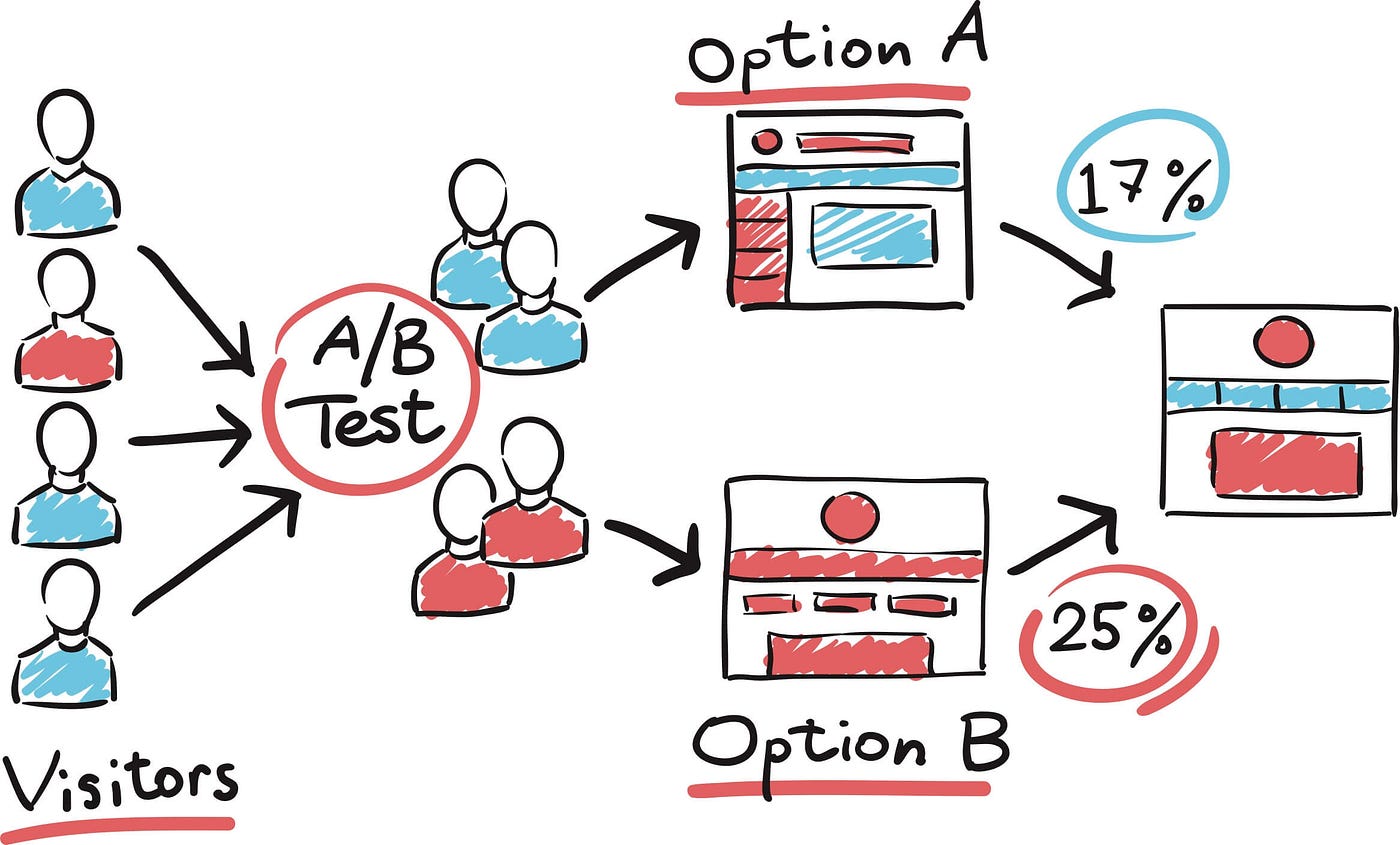
When you set up an A/B test in Voluum, the platform splits incoming traffic between your variations based on weights you define:
- Even split (50/50) — the default starting point. Each variation receives an equal share of traffic. This is the purest test because both versions face identical conditions.
- Weighted split (e.g., 70/30) — useful when you have a control version you trust and want to test a challenger with less risk. The proven version gets more traffic while the new variation is tested with a smaller sample.
- Multi-variation splits — Voluum supports testing 3, 4, or more variations simultaneously, distributing traffic across all of them. This speeds up testing when you have multiple hypotheses.
The traffic distribution happens at the redirect level — Voluum's tracking link receives the click and routes it to the appropriate landing page variation before the visitor sees anything. The process is invisible to the user and adds minimal latency.
Real-Time Analytics Dashboard
Voluum's dashboard shows performance data for each variation in real time:
- Clicks and impressions per variation.
- Conversion rate per variation.
- Revenue and cost per variation.
- ROI per variation.
- Statistical confidence indicators showing whether observed differences are meaningful or random noise.
This real-time visibility lets you monitor tests as they run — identifying clear losers early (which you can pause to save budget) and confirming winners once statistical significance is reached.
Campaign Paths and Flow Control
Voluum organizes tests through "paths" — sequences of landing pages and offers that traffic flows through. You can create multiple paths within a single campaign, each with different landing page and offer combinations:
- Path A: Landing Page 1 → Offer 1
- Path B: Landing Page 2 → Offer 1
- Path C: Landing Page 1 → Offer 2
- Path D: Landing Page 2 → Offer 2
This structure lets you test landing pages and offers independently or in combination, isolating which variable drives the performance difference.
Setting Up Your First A/B Test in Voluum Step by Step

Here's the practical process for launching a split test. Any affiliate marketing company running paid campaigns at scale uses similar testing workflows — the principles apply regardless of the specific tracking platform.
Step 1: Define Your Hypothesis
Every test needs a clear hypothesis. "I believe changing the headline from 'Save Money on Insurance' to 'Your Insurance Costs $400 More Than It Should' will increase conversion rate because specificity triggers stronger emotional response."
Without a hypothesis, you're changing things randomly. With one, every test teaches you something about your audience — even when the variation loses.
Step 2: Create Your Variations
Build the variations you want to test. For landing page tests, create two or more versions of the page with only one element changed between them. This isolation is critical — if you change the headline, image, and CTA simultaneously, you won't know which change caused the difference in results.
Step 3: Configure the Campaign in Voluum
In Voluum's campaign setup:
- Add your traffic source.
- Create multiple paths, each pointing to a different landing page variation.
- Set the traffic distribution weights (start with 50/50 for your first test).
- Assign the same offer to each path (unless you're specifically testing offers).
- Configure your postback URL so conversions from your affiliate offer are tracked back to Voluum.
Step 4: Launch With Sufficient Budget
A/B tests require enough traffic to produce statistically meaningful results. If each variation only receives 50 clicks, the data is too small to draw conclusions — random variation will dominate the results.
As a general guideline, aim for at least 100-200 conversions per variation before drawing conclusions. For campaigns with lower conversion rates, this means sending more traffic and allocating more budget to the test period.
Step 5: Monitor Without Premature Decisions
The most common testing mistake is calling a winner too early. A variation that's ahead after 20 conversions might be behind after 200. Voluum's statistical confidence indicators help — wait until the platform shows high confidence (typically 95%+) before declaring a winner.
Step 6: Implement the Winner and Test Again
Once you have a statistically significant winner, pause the losing variation, direct all traffic to the winner, and start planning your next test. The winning variation becomes your new control, and you test a new challenger against it.
This iterative cycle — test, find winner, make winner the new control, test again — produces continuous improvement that compounds over time.
Reading Test Results Correctly: Avoiding False Conclusions
The most dangerous moment in A/B testing is when you think you have a winner but the data isn't actually conclusive.
Statistical Significance: The Non-Negotiable Standard
Statistical significance measures the probability that the observed difference between variations is real rather than random chance. A 95% confidence level means there's only a 5% chance the difference is due to random variation.
Voluum calculates this automatically, but understanding the concept prevents premature decisions:
- Below 90% confidence — too early to call. The difference could easily be random noise.
- 90-95% confidence — directionally interesting but not conclusive. Continue the test.
- 95%+ confidence — statistically significant. You can act on this result with reasonable certainty.
Sample Size Matters More Than Time
A test that runs for 7 days with 30 conversions per variation is less reliable than a test that runs for 2 days with 300 conversions per variation. Statistical significance depends on sample size (number of conversions), not time elapsed.
If your campaign has a low conversion rate, you need more traffic and more time to reach meaningful sample sizes. Cutting a test short because "it's been running for a week" leads to false conclusions.
Watch for External Variables
Not all performance differences come from your variations. External factors can distort results:
- Day of week effects — user behavior differs between weekdays and weekends. Run tests for full weeks to capture both.
- Seasonal shifts — promotions, holidays, and news events can temporarily change conversion patterns.
- Traffic source changes — if the traffic source's algorithm shifts during your test, both variations are affected unevenly.
Voluum's reporting lets you segment results by date, device, geo, and other dimensions — helping you identify whether external variables are influencing your test.
Advanced Testing Strategies for Experienced Affiliates
Once you've mastered basic A/B testing, these advanced approaches extract even more performance from your campaigns.
Multivariate Testing
Instead of testing one element at a time, multivariate testing evaluates multiple elements simultaneously using different combinations. Testing 3 headlines × 2 images × 2 CTAs creates 12 variations. Voluum distributes traffic across all combinations, revealing which specific combination performs best.
The trade-off: multivariate tests require significantly more traffic because each combination needs sufficient sample size. Only use this approach when you have high-volume campaigns that generate enough data.
Sequential Testing and Iteration
The most profitable approach isn't running one big test — it's running continuous sequential tests. Test headlines first. Find the winner. Then test images with the winning headline. Find the winner. Then test CTAs with the winning headline and image. Each test builds on previous winners, creating a compounding optimization effect.
Auto-Optimization With Voluum's AI
Voluum offers AI-powered auto-optimization that automatically shifts traffic toward better-performing variations as data accumulates. Instead of waiting for full statistical significance before making changes, the algorithm continuously adjusts traffic distribution — sending more traffic to winning variations and less to losers.
This is particularly useful for campaigns with many variations where manual monitoring becomes impractical.
Testing Across Traffic Sources
The same landing page may perform differently across traffic sources. A page that converts well on Facebook traffic might underperform on native ad traffic because the audience mindset differs. Test your winning variations across each traffic source independently rather than assuming universal performance.
Common A/B Testing Mistakes That Cost Affiliates Money
These errors waste budget and lead to wrong conclusions.
Testing Too Many Things at Once
Changing the headline, image, CTA, and layout simultaneously makes it impossible to know which change caused the result. Isolate one variable per test unless you're running a properly structured multivariate test with sufficient traffic.
Stopping Tests Too Early
Excitement about early results is the number one testing mistake. A variation leading after 50 conversions might be a statistical fluke. Wait for 95%+ confidence before acting.
Ignoring Segment-Level Differences
A variation might win overall but lose on mobile devices. Or win in one country but lose in another. Voluum's segmentation tools let you analyze results by device, geo, browser, and other dimensions — revealing insights that aggregate data hides.
Not Testing Continuously
Finding one winning landing page and never testing again means your conversion rate stagnates while competitors improve theirs. Continuous testing is a habit, not a one-time project. The best affiliates always have at least one test running.
Making Decisions Based on Revenue Instead of Statistical Confidence
A variation that earned more revenue might simply have received more traffic or benefited from a few high-value conversions. Always base decisions on conversion rate with statistical significance, not raw revenue numbers.
When scaling campaigns across multiple offers and traffic sources, working through an established affiliate network provides access to diverse offers you can A/B test against each other — finding which advertiser, payout structure, and landing page combination produces the highest conversion rates and ROI for your specific traffic.
Conclusion
A/B testing in affiliate marketing is the discipline that transforms guessing into knowing. By systematically testing landing pages, ad creatives, offers, and traffic segments, you discover exactly what converts your specific audience — and you build campaigns on data rather than assumptions.
Voluum provides the infrastructure to run these tests properly — traffic distribution, real-time analytics, statistical confidence measurement, and AI-powered auto-optimization. But the tool is only as good as the testing discipline behind it.
Start with simple 50/50 landing page tests. Wait for statistical significance before declaring winners. Isolate one variable per test. Run tests continuously, not once. And let every test — even the ones where your variation loses — teach you something about your audience.
The affiliates earning the most aren't necessarily the ones with the most traffic or the biggest budgets. They're the ones who test relentlessly, learn from every result, and compound small improvements into significant competitive advantages over time.