If you're running a business, building a personal brand, or starting a career in marketing, understanding digital marketing is no longer optional — it's foundational. Every customer journey in 2026 involves a digital touchpoint, whether it's a Google search, a social media ad, an email, or a YouTube video.
But "digital marketing" is a broad term that covers dozens of channels, strategies, and tactics. For beginners, this breadth creates confusion. What should you learn first? Which channels matter most? How do all the pieces fit together?
This guide breaks down every major component of digital marketing in plain language — what each channel does, how they connect, and where to focus depending on your goals.
How Digital Marketing Differs From Traditional Marketing
Traditional marketing — TV commercials, print ads, billboards, radio spots — broadcasts a message to a wide audience and hopes the right people see it. It's expensive, difficult to measure, and largely one-directional.
Digital marketing flips this model in three fundamental ways:
- Targeting precision. Instead of showing your ad to everyone watching a TV channel, you can target people based on their search queries, demographics, interests, online behavior, and even purchase history. Google Ads lets you show ads only to people actively searching for what you sell. Meta Ads lets you reach people based on their interests and behaviors.
- Measurability. Every click, impression, conversion, and dollar spent is trackable. Google Analytics tells you exactly which channels drive traffic and sales. Traditional marketing requires expensive market research to estimate impact; digital marketing shows you the data in real time.
- Two-way interaction. Digital channels allow conversations. Customers comment on social posts, reply to emails, leave reviews, and engage with content. This feedback loop lets you refine messaging continuously.
The shift isn't about one being "better." Many successful companies use both. But digital marketing's accountability and precision make it the starting point for nearly every modern marketing strategy.
The Scale of the Digital Shift
Global digital ad spending is projected to exceed $740 billion in 2026. More than 60% of total advertising budgets now go to digital channels. For small businesses especially, digital marketing offers access to audiences that were previously reachable only by companies with massive budgets.
The Core Channels of Online Marketing Explained
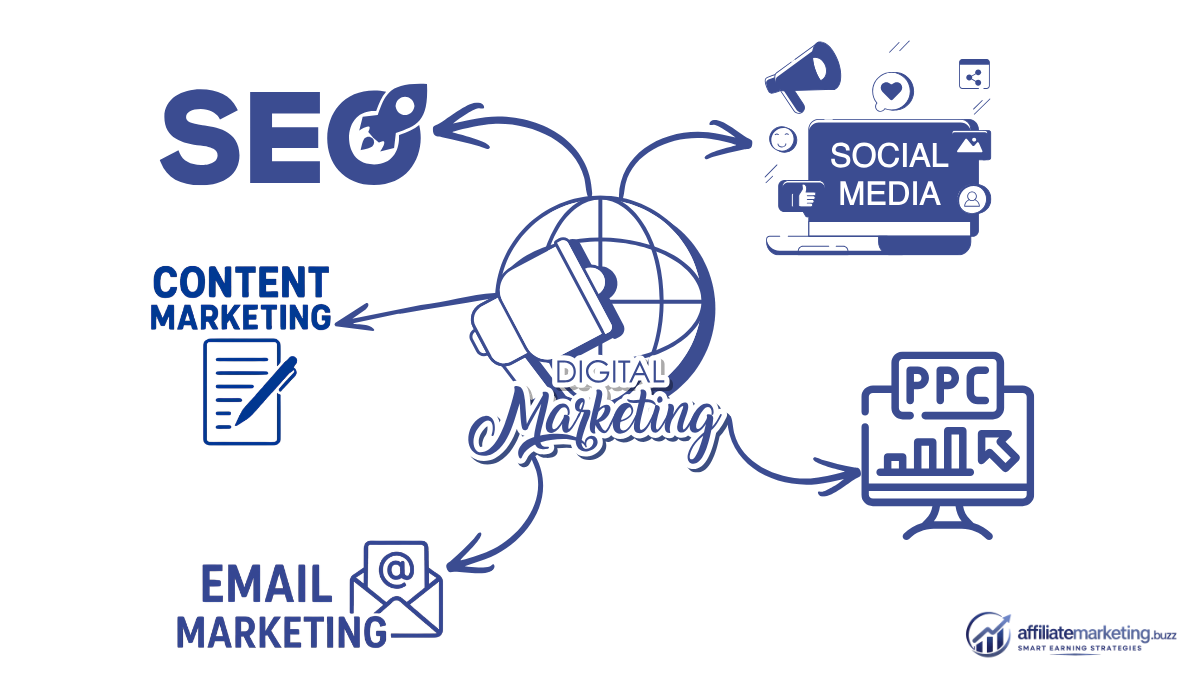
Digital marketing isn't a single activity — it's an ecosystem of channels that work together. Understanding each one helps you choose where to invest your time and budget.
Search Engine Optimization (SEO)
SEO is the practice of optimizing your website and content to rank higher in organic (non-paid) search engine results. When someone searches "best running shoes for flat feet" on Google, the sites appearing on page one earned those positions through SEO.
SEO breaks down into three pillars:
- On-page SEO — optimizing individual pages with relevant keywords, clear heading structures, quality content, internal linking, and meta tags.
- Off-page SEO — building authority through backlinks (other websites linking to yours), brand mentions, and social signals.
- Technical SEO — ensuring your site loads fast, is mobile-friendly, has clean code, proper indexing, and no crawl errors. Tools like Google Search Console and Screaming Frog help identify technical issues.
SEO is a long-term strategy. Results typically take 3–6 months, but the traffic it generates is free and compounds over time. A well-optimized article can drive visitors for years without additional spending.
For beginners, SEO is arguably the most valuable skill to learn because it underpins almost every other digital marketing channel. Content marketing, blogging, e-commerce, and even YouTube all benefit from understanding how search algorithms work.
Pay-Per-Click Advertising (PPC)
PPC is the paid counterpart to SEO. Instead of earning your position in search results, you bid for it. Google Ads is the dominant platform — you choose keywords, set a budget, and your ad appears above organic results when someone searches those terms. You pay only when someone clicks.
Other major Pay Per Click platforms include Bing Ads, Meta Ads (Facebook and Instagram), and LinkedIn Ads. Each platform has different strengths depending on your audience and goals.
PPC's advantage is speed. While SEO takes months, a PPC campaign can drive traffic within hours of launching. The trade-off is cost — once you stop paying, the traffic stops. The most effective strategies use PPC for immediate results while building SEO for long-term sustainability.
Social Media Marketing
Social media marketing uses platforms like Instagram, TikTok, YouTube, LinkedIn, Pinterest, and X (formerly Twitter) to build brand awareness, engage audiences, and drive traffic.
Each platform serves different purposes:
- Instagram and TikTok — visual content, short-form video, brand building, and product discovery. Strong for B2C brands targeting younger demographics.
- LinkedIn — professional networking, B2B marketing, thought leadership, and recruiting.
- YouTube — long-form video content, tutorials, product reviews. Functions as both a social platform and the world's second-largest search engine.
- Pinterest — visual search engine used heavily for product discovery in niches like home decor, fashion, food, and DIY.
Social media can be organic (free posting) or paid (sponsored content and ads). Most brands need a combination. Organic builds community and trust; paid extends reach to people who haven't discovered you yet.
Content Marketing
Content marketing is the strategy of creating valuable, relevant content to attract and retain an audience — and ultimately drive profitable customer action. Blog posts, videos, podcasts, infographics, ebooks, case studies, and newsletters all fall under this umbrella.
The principle is simple: instead of interrupting people with ads, you create something they actually want to consume. A financial services company publishing genuinely helpful retirement planning guides earns trust that no banner ad can replicate.
Content marketing works hand-in-hand with SEO. The content you create becomes the material that ranks in search engines, gets shared on social media, and drives email signups. Without content, there's nothing to optimize or promote.
Email Marketing
Email marketing remains one of the highest-ROI channels in digital marketing. For every $1 spent, email marketing generates an average of $36–$42 in return, according to industry studies.
Why? Because your email list is an owned audience. Unlike social media followers (subject to algorithm changes) or search traffic (subject to ranking fluctuations), email subscribers have given you explicit permission to reach them.
Platforms like Mailchimp, MailerLite, ConvertKit, and HubSpot offer tools for building lists, designing emails, creating automation sequences, and tracking open rates and click-through rates.
Effective email marketing for beginners starts with three elements: a lead magnet (free resource in exchange for an email address), a welcome sequence (automated emails introducing your brand), and consistent newsletters (regular value-driven content with strategic offers).
How Affiliate Marketing Fits Into the Digital Marketing Ecosystem
Affiliate marketing is a performance-based channel within digital marketing where businesses pay external partners (affiliates) a commission for driving traffic or sales through their promotional efforts.
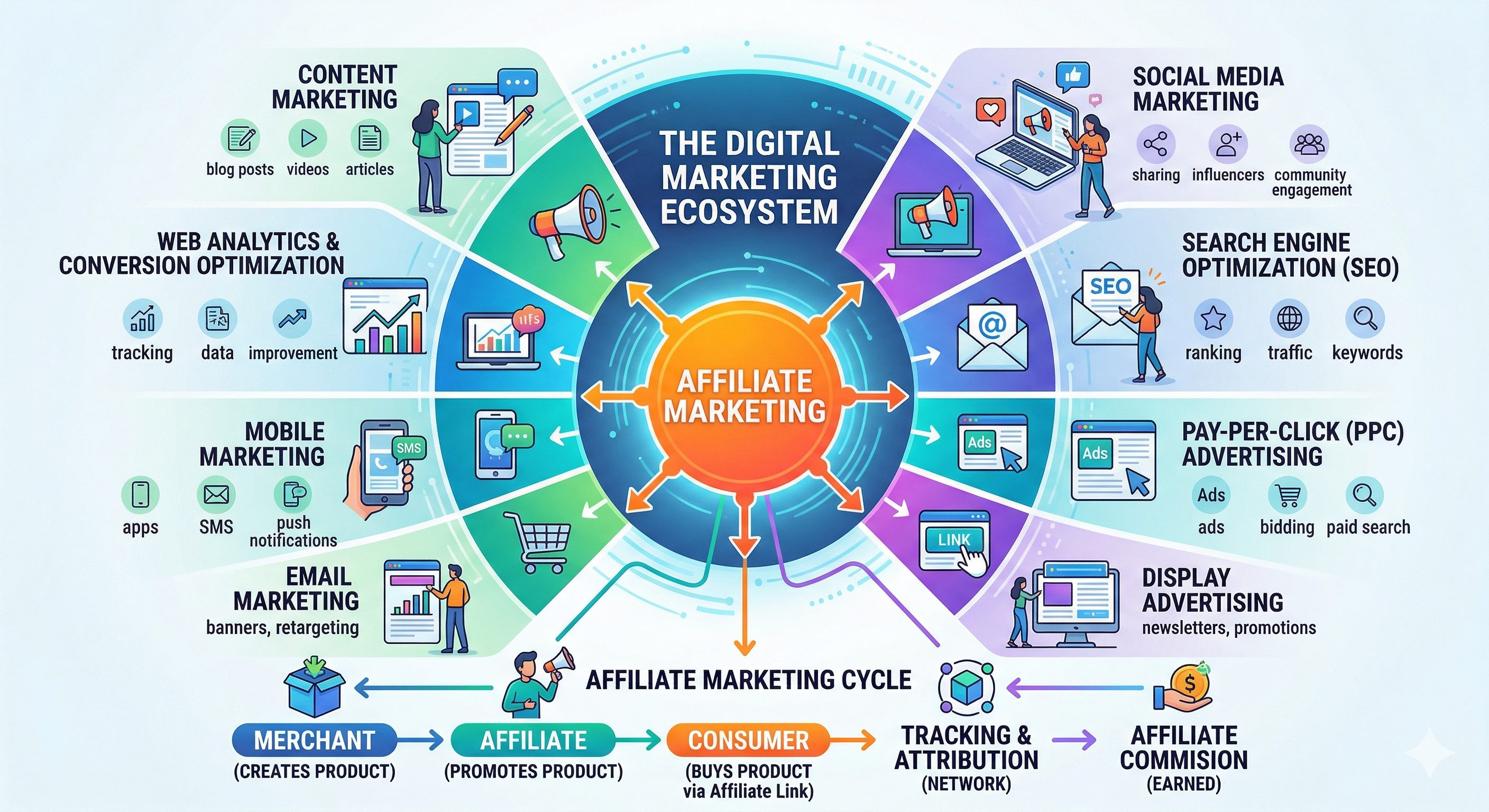
It sits at the intersection of content marketing, SEO, and partnership strategy. Here's how it connects:
How the Affiliate Model Works
The structure involves four parties:
- The merchant — a business selling a product or service.
- The affiliate — a content creator, blogger, or marketer who promotes the merchant's products.
- The consumer — the person who clicks a referral link and makes a purchase.
- The affiliate network — an intermediary platform that connects merchants with affiliates, handles tracking, and manages payments. Major networks include ShareASale, CJ Affiliate, ClickBank, and Rakuten Advertising.
The merchant only pays when a result happens — a sale, a lead, or a specified action. This makes affiliate marketing one of the most cost-efficient customer acquisition channels available.
Why Brands Invest in Affiliate Partnerships
For businesses, affiliate marketing provides access to audiences they couldn't reach through their own channels alone. Instead of spending on ads that may or may not convert, they leverage trusted content creators whose audiences already trust their recommendations.
An affiliate network simplifies this by providing tracking technology, reporting dashboards, and payment processing. Without networks, merchants would need to build custom tracking systems and manage hundreds of individual affiliate relationships — which is why even large companies prefer using established networks.
For individual affiliates, the appeal is clear: earn commission-based income by recommending products through content you'd create anyway. It requires no product creation, no inventory, and no customer support.
Understanding Pay Per Call and Performance Marketing Models
Most people are familiar with pay-per-click (PPC), but pay per call is a performance marketing model that's growing fast — particularly in industries where phone conversations drive high-value conversions.
What Is Pay Per Call?
In a pay per call campaign, advertisers pay publishers or affiliates a commission when a qualified phone call is generated. Instead of tracking clicks or form submissions, the conversion event is an actual phone call that meets specific criteria — typically a minimum call duration (e.g., 60 seconds or more).
This model thrives in industries where customers need to speak with someone before purchasing:
- Legal services — someone searching "personal injury lawyer near me" is far more likely to call than to fill out a form.
- Insurance — comparing policies often requires a conversation with an agent.
- Home services — plumbing, HVAC, roofing — customers want to describe their problem and get a quote.
- Healthcare — patients booking appointments or consultations.
How Pay Per Call Connects to Digital Marketing
Pay per call campaigns use the same digital channels as other marketing models — Google Ads, Facebook Ads, SEO-driven landing pages, and even affiliate partnerships. The difference is that the call-to-action is a phone number rather than a "Buy Now" button or form.
Tracking technology assigns unique phone numbers to different campaigns, allowing advertisers to attribute each call to its source. Platforms like Invoca, Ringba, and CallRail specialize in this tracking.
For marketers, pay per call is worth understanding because it often commands significantly higher payouts than standard CPA (cost per action) models. A single qualified call in the insurance or legal space can pay $50–$200+, compared to $5–$20 for a typical web lead.
How to Build a Digital Marketing Strategy From Scratch
Knowing the channels is one thing. Putting them together into a coherent strategy is where beginners often struggle. Here's a practical framework.

Define Your Goals First
Every strategy starts with a clear objective. Common digital marketing goals include:
- Brand awareness — getting your name in front of new audiences (measured by impressions, reach, and social followers).
- Lead generation — collecting contact information from potential customers (measured by form submissions, email signups, or phone calls).
- Sales and conversions — driving direct purchases (measured by revenue, conversion rate, and return on ad spend).
- Customer retention — keeping existing customers engaged (measured by repeat purchase rate, email engagement, and lifetime value).
Your goal determines which channels to prioritize. Brand awareness might lean on social media and display advertising. Lead generation might focus on SEO, content marketing, and email. Direct sales might require PPC and retargeting.
Choose Channels Based on Your Audience
Not every channel suits every business. A B2B software company will get better results on LinkedIn and Google Ads than on TikTok. A fashion e-commerce brand will thrive on Instagram and Pinterest but waste time on LinkedIn.
Ask two questions:
- Where does my target audience spend time online?
- What is their intent on that platform — browsing, researching, or ready to buy?
Start With Two Channels, Then Expand
A common beginner mistake is trying to be everywhere at once — posting on five social platforms, running ads, writing blog posts, and building an email list simultaneously. This guarantees mediocre results across the board.
Instead, pick two channels that match your goals and audience. Master them. Then add more as you build capacity.
For most beginners, a strong starting combination is:
- SEO + Content Marketing — build a foundation of helpful content that attracts organic traffic over time.
- Email Marketing — capture that traffic into a list you own, then nurture those subscribers toward conversion.
Once this foundation generates consistent results, layer in social media, PPC, or affiliate marketing partnerships.
Measure Everything and Iterate
Digital marketing's greatest advantage is measurability. Use Google Analytics to track traffic sources, conversion paths, and user behavior. Use Google Search Console to monitor SEO performance. Use platform-specific analytics (Meta Ads Manager, YouTube Analytics) to evaluate paid and social efforts.
Review your data monthly. Double down on what works. Cut what doesn't. Marketing strategy isn't a fixed plan — it's a continuous cycle of testing, learning, and optimizing.
Essential Free Tools for Beginners Getting Started
You don't need expensive software to launch your first digital marketing efforts. These free tools cover the fundamentals:
Analytics and Research
- Google Analytics (GA4) — tracks website traffic, user behavior, and conversions. Non-negotiable for any digital marketer.
- Google Search Console — monitors your site's search performance, indexing status, and technical health.
- Google Trends — validates whether topics and keywords have growing or declining search interest.
Content and Design
- Canva (free tier) — create social media graphics, blog images, and marketing materials without design skills.
- WordPress — the most popular content management system. The free tier of WordPress.com works for beginners; self-hosted WordPress.org offers full flexibility.
- Grammarly (free tier) — catches writing errors that undermine professionalism.
Social Media and Email
- Buffer (free tier) — schedule social media posts across three platforms.
- Mailchimp (free up to 500 subscribers) or MailerLite (free up to 1,000 subscribers) — build and manage your email list with automation.
SEO Tools
- Ubersuggest (limited free searches) — keyword research with volume and difficulty data.
- Ahrefs Webmaster Tools — free site audit and backlink analysis for your own domain.
- AnswerThePublic — discover long-tail questions and search queries around any topic.
These tools give you enough capability to research, create, publish, distribute, and measure — the complete digital marketing cycle — without spending anything.
Conclusion
Digital marketing is the ecosystem of channels, tools, and strategies businesses use to reach customers online — from SEO and content marketing to PPC, social media, email, affiliate marketing, and performance models like pay per call.
For beginners, the key isn't learning everything at once. It's understanding how the pieces connect, choosing two channels that match your goals, and executing consistently with free tools until results justify investment.
The landscape will keep evolving — AI, voice search, privacy regulations, and new platforms will reshape tactics. But the fundamentals remain constant: understand your audience, create genuine value, measure results, and adapt. Master those, and every new channel or trend becomes an extension of a strategy that already works.