SEO — search engine optimization — is the practice of improving your website so it appears higher in organic search engine results. When someone types a query into Google, the sites on page one didn't land there by accident. They earned those positions through a combination of relevant content, technical health, and authority signals that search engines recognize and reward.
In 2026, SEO remains the highest-ROI channel in digital marketing. Organic search drives over 53% of all website traffic globally, according to BrightEdge research. Unlike paid advertising, where traffic stops the moment your budget runs out, organic rankings compound over time — a well-optimized page can generate free traffic for years.
But SEO has evolved dramatically. It's no longer about stuffing keywords into pages and buying links. Modern SEO requires understanding search intent, creating genuinely helpful content, maintaining technical excellence, and building real authority. This guide explains how every piece works.
How Search Engines Actually Work Behind the Scenes
Before you can optimize for search engines, you need to understand what they're doing. Google processes over 8.5 billion searches daily. Delivering relevant results at that scale requires a sophisticated three-stage process.
Crawling: Discovering Your Pages
Google uses automated programs called crawlers (or spiders) to discover web pages. The most well-known is Googlebot. These crawlers follow links from page to page, discovering new content and revisiting existing pages for updates.
If Googlebot can't find or access your pages, they won't appear in search results — no matter how good the content is. This is why technical SEO fundamentals like a clean robots.txt file, an XML sitemap submitted through Google Search Console, and a logical internal linking structure matter. They ensure crawlers can discover and access every important page on your site.
Indexing: Understanding and Storing Content
Once a page is crawled, Google processes and stores it in its index — a massive database of web pages. During indexing, Google analyzes the page's content, images, meta tags, and structured data to understand what the page is about.
Not every crawled page gets indexed. Pages with thin content, duplicate content, noindex tags, or technical errors may be crawled but excluded from the index. Google Search Console's "Pages" report shows you exactly which pages are indexed and which are excluded, with reasons.
Ranking: Ordering Results by Relevance and Quality
When someone searches, Google's algorithm pulls relevant pages from its index and ranks them based on hundreds of factors. Google has confirmed several major ranking signals:
- Relevance — does the content match the search query's intent?
- Quality — does the content demonstrate E-E-A-T (Experience, Expertise, Authoritativeness, Trustworthiness)?
- Usability — is the page fast, mobile-friendly, and easy to navigate (measured partly through Core Web Vitals)?
- Authority — do other reputable sites link to this page?
Understanding this three-stage process helps you diagnose problems. If your pages aren't appearing at all, it's a crawling or indexing issue. If they appear but rank poorly, it's a relevance, quality, or authority issue.
The Three Pillars of SEO Strategy
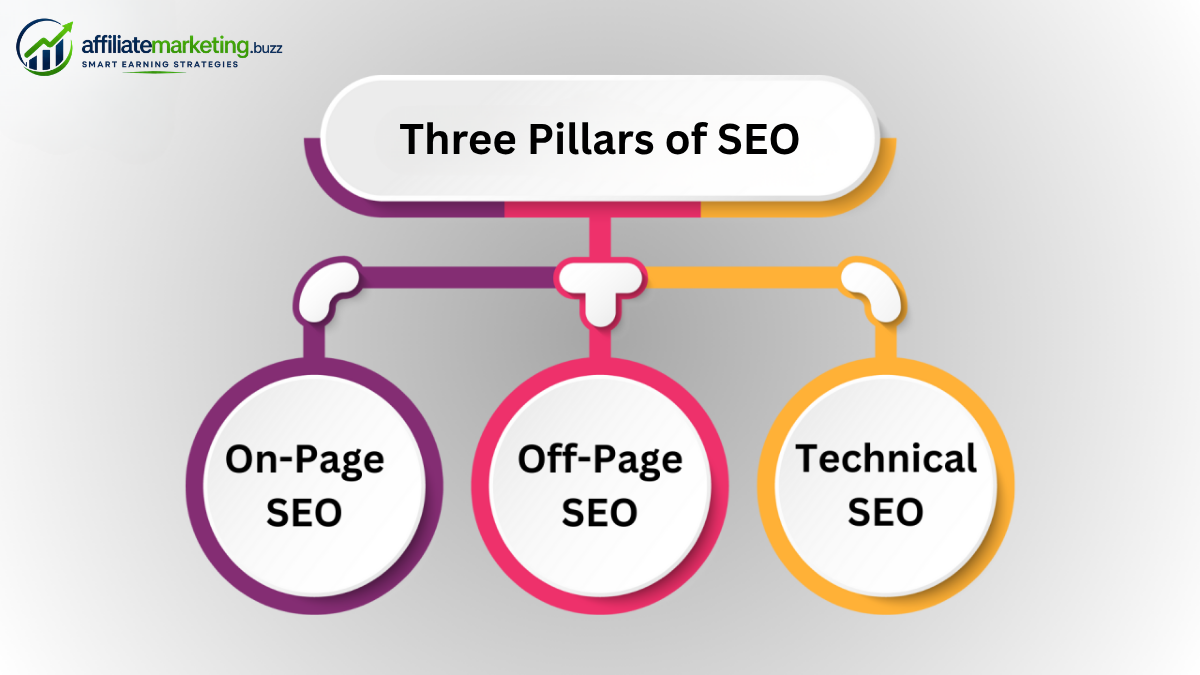
Every SEO strategy, whether for a personal blog or a Fortune 500 company, rests on three pillars: on-page, off-page, and technical optimization. Neglecting any one of them limits your results.
On-Page SEO: Optimizing What Users See
On-page SEO covers everything you control directly on your website. This is where most beginners should focus first because the improvements are immediate and don't depend on external factors.
Key on-page elements include:
- Title tags — the clickable headline in search results. Include your target keyword naturally, keep it under 60 characters, and make it compelling enough to earn clicks. This single element has an outsized impact on rankings and click-through rate.
- Meta descriptions — the snippet below the title in search results. While not a direct ranking factor, a well-written meta description increases click-through rate, which indirectly helps rankings.
- Header structure (H1–H4) — use one H1 per page containing your primary keyword. Use H2s and H3s to organize content logically. This helps both readers and search engines understand your page structure.
- Content quality and depth — Google's helpful content system rewards content that demonstrates firsthand experience and provides genuine value. A 2,000-word article that thoroughly answers a question will outrank a 300-word article that barely skims the surface.
- Internal linking — linking between your own pages using descriptive anchor text helps Google discover and understand relationships between your content. It also keeps visitors on your site longer, reducing bounce rate.
- Image optimization — compress images for fast loading, use descriptive alt text, and choose relevant file names. Tools like Google PageSpeed Insights flag image optimization opportunities.
- Keyword placement — include your target keyword in the title, first 100 words, one H2, and naturally throughout the body. Keyword density of 1–1.2% is a useful benchmark, but natural readability always takes priority over forced insertion.
Off-Page SEO: Building Authority and Trust
Off-page SEO encompasses everything that happens outside your website that influences your rankings. The most important factor is backlinks — links from other websites pointing to yours.
Google treats backlinks as votes of confidence. A link from a reputable site like a major news publication or an established industry blog carries far more weight than links from low-quality directories or spam sites.
Effective link building strategies include:
- Creating linkable content — original research, comprehensive guides, data studies, and unique tools naturally attract links because other sites reference them.
- Guest posting — writing articles for other blogs in your niche with a link back to your site. Focus on quality publications relevant to your topic.
- Digital PR — getting mentioned or quoted in news articles, podcasts, and industry publications.
- Broken link building — finding broken links on other websites and offering your content as a replacement.
What to avoid: buying links, participating in link schemes, or using private blog networks (PBNs). These are black hat SEO tactics that violate Google's guidelines. Google's spam detection has become sophisticated enough that these tactics carry serious risks, including manual penalties that can remove your site from search results entirely.
Tools like Ahrefs, Moz, and Majestic help you analyze your backlink profile and identify opportunities. Ahrefs Webmaster Tools offers a free version for auditing your own site's backlinks.
Technical SEO: The Foundation Everything Sits On
Technical SEO ensures search engines can efficiently crawl, index, and render your website. Even the best content won't rank if technical problems prevent Google from processing it properly.
Critical technical SEO elements:
- Site speed — Google has confirmed page speed as a ranking factor. Core Web Vitals — Largest Contentful Paint (LCP), Interaction to Next Paint (INP), and Cumulative Layout Shift (CLS) — measure real-world user experience. Use Google PageSpeed Insights and Chrome DevTools to diagnose speed issues. Common fixes include image compression, browser caching, code minification, and using a CDN like Cloudflare.
- Mobile-first indexing — Google predominantly uses the mobile version of your site for ranking and indexing. If your mobile experience is poor — slow, cluttered, or missing content that appears on desktop — your rankings suffer across all devices.
- HTTPS — secure sites rank better than non-secure ones. An SSL certificate is a baseline requirement in 2026.
- Structured data (Schema markup) — adding Schema.org markup helps Google understand your content's context. Product reviews, FAQs, how-to guides, and articles all have specific schema types that can earn rich snippets in search results — enhanced listings with star ratings, FAQ accordions, or step-by-step previews that dramatically increase click-through rates.
- XML sitemaps and robots.txt — your sitemap tells Google which pages exist. Your robots.txt file tells crawlers which pages to skip. Both should be configured correctly and submitted through Google Search Console.
- Canonical tags — prevent duplicate content issues by specifying the preferred version of a page when similar content exists at multiple URLs.
Regular technical audits using tools like Screaming Frog (free for up to 500 URLs) or SEMrush's site audit feature catch problems before they impact rankings.
Key Benefits of SEO for Businesses and Creators
Investing in SEO delivers advantages that few other digital marketing channels can match.
Compounding Organic Traffic
Paid ads deliver traffic proportional to your spend. SEO delivers traffic that compounds. An article ranking on page one of Google continues generating visitors for months or years without additional cost. The more quality content you publish and optimize, the more total organic traffic your site accumulates.
For businesses with limited marketing budgets, this compounding effect makes SEO the most cost-efficient channel over a 12+ month timeframe.
Higher Trust and Click-Through Rates
Studies consistently show that organic results receive significantly more clicks than paid ads for informational and research queries. Users trust organic rankings because they know those positions were earned, not bought. This trust translates to higher engagement, longer time on page, and better conversion rates.
Supporting Every Other Marketing Channel
SEO amplifies every other digital marketing effort. Social media posts perform better when they link to optimized, high-ranking content. Email campaigns convert better when subscribers land on fast, well-structured pages. Even paid ad campaigns benefit — a strong organic presence builds brand familiarity that increases ad click-through rates.
Affiliate marketing depends heavily on SEO. Affiliates who rank for buyer-intent keywords like "best project management software" or "SEMrush vs Ahrefs" generate consistent referral traffic that converts into commissions. Without organic search visibility, most affiliate marketers rely on paid traffic that eats into their margins.
Local Visibility for Service Businesses
Local SEO — optimizing for location-specific searches like "plumber near me" or "best coffee shop in Austin" — drives foot traffic and phone calls for brick-and-mortar businesses. Google Business Profile optimization, local citations, and location-specific content help service businesses appear in Google's map pack and local search results.
How SEO Powers Affiliate Marketing and Monetization
The connection between SEO and affiliate marketing is direct and powerful. Most successful affiliate marketers generate the majority of their income through organic search traffic.
Why SEO Is the Best Traffic Source for Affiliates
When someone searches "best wireless headphones under $100," they're expressing buyer intent — they've decided to purchase and are looking for guidance on which product to choose. An affiliate blog post ranking for that query intercepts a potential buyer at exactly the right moment.
This is fundamentally different from social media traffic, where users are browsing casually, or paid traffic, where the cost of acquisition reduces profit margins. SEO-driven visitors arrive with intent already established, making them significantly more likely to click affiliate links and complete purchases.
Monetizing SEO Skills Through Affiliate Programs
The tools you use for SEO can themselves become income sources through affiliate marketing. The SEMrush affiliate program, for example, pays recurring commissions when you refer new subscribers to SEMrush — one of the most widely used SEO toolsets.
Similar programs exist across the SEO tool ecosystem. Ahrefs, Moz, Mangools, and SE Ranking all offer affiliate partnerships. If you're already writing about SEO and recommending tools, joining these programs lets you earn from recommendations you'd make anyway.
Beyond individual programs, joining an affiliate network like ShareASale, CJ Affiliate, or Impact gives you access to hundreds of brands across every niche. For SEO professionals and bloggers, this means monetizing your content without building your own products.
Building an Affiliate Site With SEO as the Foundation
The playbook for an SEO-driven affiliate site follows a clear structure:
- Choose a niche with products people actively search for and affiliate programs that pay meaningful commissions.
- Conduct keyword research to identify buyer-intent queries you can realistically rank for — especially long-tail keywords with lower competition.
- Create comprehensive content — product reviews, comparisons, and buying guides — that genuinely helps readers make informed decisions.
- Build authority through quality backlinks and topical depth, establishing your site as the go-to resource in your niche.
- Track and optimize using Google Analytics and Google Search Console, focusing on pages that drive the most affiliate clicks and revenue.
This intersection of SEO and affiliate marketing creates a sustainable business model where organic traffic generates commissions without ongoing ad spend.
SEO in 2026: How AI and Algorithm Updates Are Changing the Game
SEO in 2026 looks different from even two years ago. Google's integration of AI into search, ongoing algorithm updates, and evolving user behavior are reshaping best practices.

Google's AI Search Experience
Google's Search Generative Experience (SGE) places AI-generated summaries at the top of many search results. This changes the game for SEO practitioners because some queries now get answered directly in the SERP — the user never clicks through to a website.
The sites that still earn clicks are those providing depth, original perspective, and information the AI summary doesn't cover. Thin content that simply restates widely available facts loses value. Original research, firsthand experience, expert analysis, and unique data become more important than ever.
E-E-A-T as a Ranking Priority
Google's emphasis on Experience, Expertise, Authoritativeness, and Trustworthiness (E-E-A-T) continues to intensify. Content written by someone with demonstrable experience in a topic — not just surface-level knowledge — receives preferential treatment, particularly in YMYL (Your Money or Your Life) categories like health, finance, and legal topics.
For creators, this means author bios matter, personal experience signals matter, and building a recognizable expert brand matters. Anonymous content farms are losing ground to identifiable experts.
Core Web Vitals and User Experience Signals
Page experience metrics remain part of Google's ranking system. Sites that load fast (LCP under 2.5 seconds), respond quickly to interaction (INP under 200 milliseconds), and maintain visual stability (CLS under 0.1) have a ranking advantage.
These aren't just abstract metrics. They reflect real user experience. A site that takes 6 seconds to load loses visitors regardless of how good the content is. Tools like Google PageSpeed Insights, Chrome DevTools, and Cloudflare's performance features help meet these thresholds.
Voice Search and Conversational Queries
With smart speakers and voice assistants growing in usage, conversational queries are increasing. People searching by voice use natural language — "what's the best way to learn SEO in 2026" instead of "learn SEO 2026." Optimizing for these longer, question-based queries through FAQ sections, conversational headings, and direct-answer formatting helps capture this growing segment.
Essential SEO Tools for Beginners and Professionals
The right tools make SEO measurable and manageable. Here's what's worth using at each level.
Free Tools Every SEO Practitioner Needs
- Google Search Console — your most important free tool. Shows which queries bring impressions and clicks, identifies indexing problems, and alerts you to manual actions. Every SEO workflow starts here.
- Google Analytics (GA4) — tracks visitor behavior, traffic sources, conversion paths, and engagement metrics across your entire site.
- Google PageSpeed Insights — analyzes Core Web Vitals and provides specific recommendations for improving page speed.
- Ubersuggest (limited free searches) — keyword research with search volume, difficulty scores, and content ideas. Adequate for beginners before upgrading to premium tools.
- Ahrefs Webmaster Tools — free site audit and backlink analysis for sites you own. Identifies technical issues and shows who links to you.
- Screaming Frog (free up to 500 URLs) — desktop crawler that catches broken links, duplicate titles, missing meta descriptions, redirect chains, and other technical issues.
Premium Tools Worth the Investment
- SEMrush — the most comprehensive SEO and digital marketing toolkit. Keyword research, site audits, competitor analysis, rank tracking, backlink analysis, and content optimization in one platform. The SEMrush affiliate program also lets you earn by recommending it.
- Ahrefs — excels at backlink analysis and keyword research. Its Content Explorer feature reveals what's already ranking and earning links in any niche.
- Moz Pro — strong for domain authority tracking, local SEO, and beginner-friendly reporting.
- SpyFu — specializes in competitor keyword and PPC analysis, showing you exactly what your competitors rank for and what they bid on.
For beginners, start with the free tools. They cover 80% of what you need. Upgrade to SEMrush or Ahrefs when your site grows enough that the data insights justify the subscription cost — or offset it through their affiliate programs.
Conclusion
SEO is the practice of earning organic search visibility through relevant content, technical excellence, and authority building. It remains the most cost-efficient channel in digital marketing because the traffic it generates is free, compounds over time, and carries high intent.
Understanding SEO's three pillars — on-page optimization, off-page authority, and technical health — gives you a framework that applies whether you're building a personal blog, scaling an e-commerce store, or growing an affiliate marketing business through an affiliate network.
The landscape is evolving with AI-powered search, stricter quality standards, and shifting user behaviors. But the core principle hasn't changed: create genuinely helpful content, make it technically accessible to search engines, and earn trust from both users and the broader web. Do that consistently, and organic rankings follow.